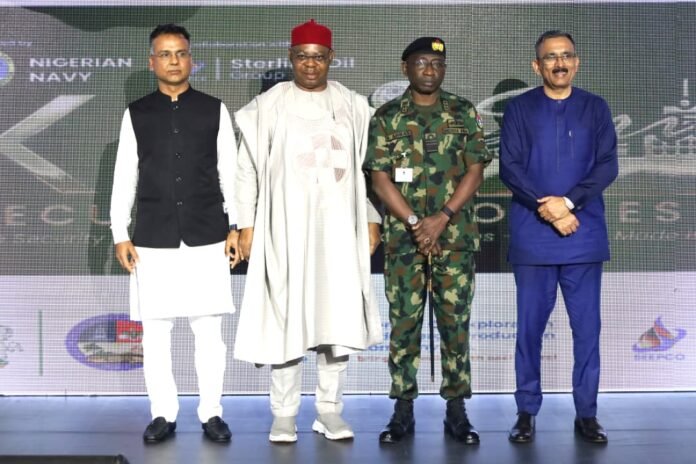
All those who witnessed the commissioning/induction ceremony of Kali-3, the purpose-built vessel constructed by Sterling Oil Exploration and Energy Production Company Limited (SEEPCO), are clearly excited for many reasons: the vessel was built by Niger Delta youths on a Niger Delta soil and sponsored by an oil firm operating in the Niger Delta.
This much was reflected in the speech delivered by the governor of Delta State, Sheriff Oborevwori, as he formally handed over the facility to the Nigerian Navy. Full of ecstasy, the governor described the project as a monumental milestone for SEEPCO, the Nigerian Navy, Delta State and Nigeria at large.
The governor who was represented by his deputy, Sir Monday Onyeme, noted that the development was a strong testament to indigenous industrial capacity, effective local content integration, and robust public-private synergy between corporate enterprise and the Nigerian Navy.
He expressed immense pride in the fact that the sophisticated vessel was designed and constructed within Delta State, noting that the achievement validates his administration’s commitment to fostering a business-friendly environment backed by skilled local manpower and technical enterprise.
He said: “This is an important occasion for SEEPCO, Delta State and Nigeria. We are celebrating not only a new security vessel, but also indigenous capacity, local content and a successful partnership between the private sector and the Nigerian Navy.
I congratulate the management of SEEPCO on this achievement and commend the Nigerian Navy for its partnership and professional contribution.
“I am particularly proud that this next-generation vessel was designed and built here in Delta State; it demonstrates that our state has created an enabling environment for businesses to thrive, while possessing the human capital, technical expertise and industrial capacity to produce sophisticated assets for strategic sectors of our economy.
“The SSV-KALI 3 will add valuable capacity to these efforts, it will strengthen maritime security, help protect oil and gas assets, and support the fight against oil theft, illegal bunkering and other maritime crimes.
“A secure operating environment is essential for investment, production and economic growth; Delta State, therefore, remains open for business, and we will continue to work with investors, security agencies and other stakeholders to sustain the peace and security required for businesses to thrive.
“I urge the operators of the vessel to maintain the highest standards of professionalism, discipline and safety; let the SSV-KALI 3 stand as a symbol of what we can achieve when government, indigenous enterprise and our security institutions work together in the national interest.”
KALI 3 is a next-generation Security Patrol Vessel, proudly designed and built in Nigeria to the highest applicable international standards for vessels of its class.
Developed with sustainability and operational resilience in mind, the vessel is designed to support the protection and surveillance of Nigeria’s maritime environment, with capabilities spanning coastal and offshore security, interdiction, anti-piracy operations and maritime law enforcement.
KALI 3 is part of the SSV series, comprising 10 Security Support Vessels under IMO certification and equipped for operations within Sea Area 3, as defined under the Global Maritime Distress and Safety System (GMDSS).
The vessel is ISO certified and incorporates class-compliant safety and life-saving appliances, reflecting a strong commitment to operational safety, reliability and resilience.
Built at the Okpai HM Shipyard in Delta State, Nigeria, in collaboration with the Nigerian Navy, it also represents a significant milestone in the development of indigenous shipbuilding and maritime engineering capability in Nigeria.
The vessel has been developed for maritime security and escort operations, including the protection of crude oil tankers, LNG carriers and offshore supply vessels operating within Nigeria’s maritime domain.
With an operational autonomy of approximately 10–12 days, KALI 3 is designed to support extended missions at sea, with onboard provisions, fuel and maintenance capacity.
Its approximately 2.5-metre draft enables operations in shallow waters and creeks, while its RHIBs support rapid boarding and response operations.
KALI 3 is equipped with modern navigation, surveillance and communication systems, including DGPS, GPS Compass, S-band radar and AIS, alongside Inmarsat-C satellite communications, MF/HF DSC Class A radio, VHF DSC radio, EPIRB and SART for maritime safety and long-range communication. The vessel’s design was developed under Bureau Veritas rules and regulations, with structural integrity verified through Bureau Veritas classification-approved design. It is designed to comply with SOLAS, MARPOL and relevant IMO standards.
Crew welfare has also been incorporated into the vessel’s design, with air-conditioned accommodation, noise and vibration insulation, ergonomic bunks with safety straps, mess and galley facilities, freshwater production, laundry facilities, showers, toilets and secure personal lockers. A dedicated sewage treatment plant supports compliance with applicable MARPOL requirements. KALI 3 demonstrates Nigeria’s growing capacity to deliver advanced maritime platforms locally, combining international marine engineering expertise with indigenous shipbuilding capability.
A representative of SEEPCO, Mr Raj Bhargava, said the vessels are being delivered in collaboration with the Nigerian Navy to bolster maritime safety and protect personnel guarding the country’s waterways.
Our correspondent quoted a top official of SEEPCO as saying that the company decided to undertake the vessel-building project as part of a public-private partnership aimed at supporting the Nigerian Navy and strengthening maritime security in Nigeria.
“As a company whose operations are closely connected to the country’s waterways, we understand the importance of a safe and secure maritime environment to the oil and gas industry, as well as to the communities and economic activities that depend on our waterways.
“Ultimately, the initiative is about strengthening the operational capacity of the Nigerian Navy, supporting maritime security and demonstrating how public-private partnerships can contribute to building a stronger and more self-reliant maritime sector in Nigeria.”
Also, speaking, the Chief of the Naval Staff, Vice Admiral Idi Abbas underscored the need for the protection of Nigeria’s maritime environment and critical energy assets, particularly the oil and gas sector.
He commended SEEPCO for embarking on the project and urged other responsible maritime stakeholders to support partnerships that advance national security and charged the personnel assigned to operate the vessel to uphold the highest standards of professionalism, discipline, integrity and operational readiness, while reaffirming the Nigerian Navy’s commitment to strengthening partnerships that enhance maritime security.

